Weekly Edition
31 August 2026 · 9 min read
#44: Seven AI tools, one household, seven different answers on money.
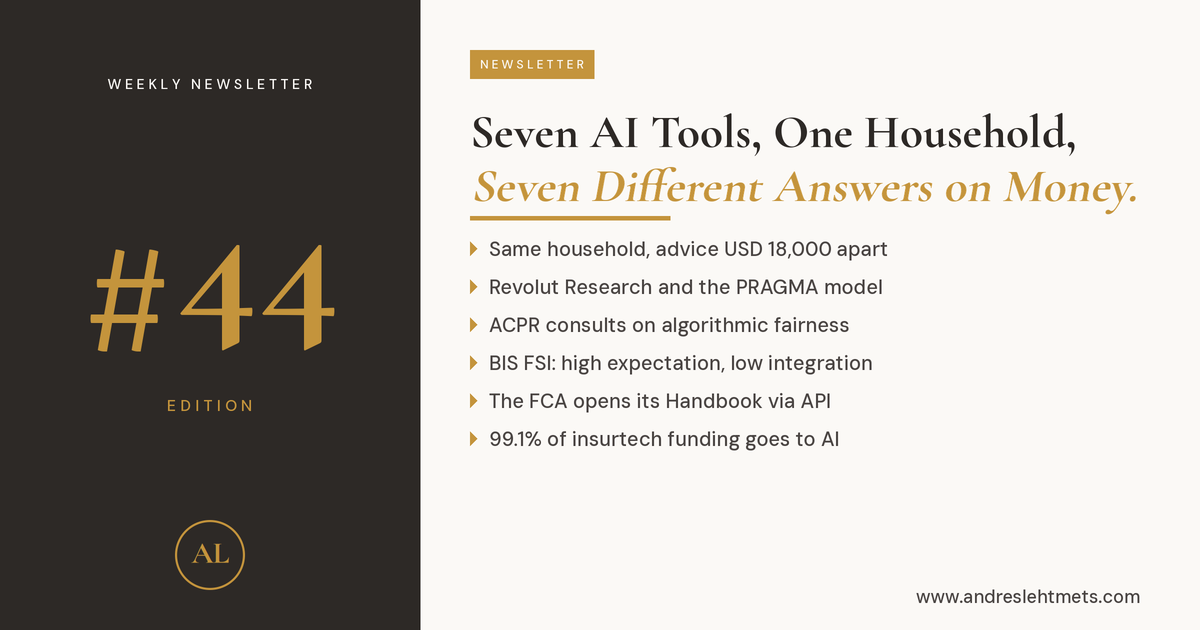
Seven AI tools, one household, seven different answers on money
AI advice divergence · Revolut’s PRAGMA · ACPR on algorithmic fairness · SupTech · 99.1% of insurtech funding goes to AI
This edition arrives after a summer pause, and with a small milestone. August marked two years since I left EIOPA and one full year of running my own advisory practice. There was no grand plan at the start, just the decision to try. Heading into another year I can finally say it with confidence: the business is sustainable. For that I am grateful to the clients who extend their contracts and come back, and to the network of experts around the world whose skills make the larger projects possible.
Autumn is planning season here. If you are mapping out next year and see a place where we could work together, have a look at how I can help or simply reply to this email.
The same household asked seven AI tools about money. The answers differed by USD 18,000.
The Journal of Financial Planning published a study in June testing whether different generative AI tools give different financial recommendations. The setup was simple: identical prompts about the same household put to ChatGPT, Claude, Gemini, Copilot, DeepSeek, Meta AI and Perplexity, on three questions every adviser knows. How much emergency savings to hold, what retirement withdrawal rate to use and how to allocate a portfolio.
- Emergency savings produced the widest spread. Recommendations ranged from USD 19,500 to USD 37,500 for the same household, a statistically significant gap. Every tool reasoned in months of living expenses, which is textbook, but they disagreed on how many months and on what the household actually spends.
- Withdrawal rates were the consistent one. Most tools converged on the traditional 4% rule of thumb.
- Portfolio allocation was not. Equity exposure varied sharply for the same low risk profile, and Gemini declined the question entirely, telling the user to consult a licensed adviser.
- Some tools changed their recommendations when only the household’s race or gender was varied. Others did not.
The authors’ conclusion is measured: generative AI is a useful starting point, not a replacement for professional advice.
The supervisory reading is less comfortable. A consumer uses one tool and never sees the spread, and each answer on its own sounds authoritative. Finding number 4 is the one that turns this from a quality question into a conduct and discrimination question. The FCA has just been formally tasked with reviewing the consumer impact of advice-like outputs from general purpose models, covered in edition #43, and studies like this one are the evidence base such reviews will draw on. Read the study.
Revolut launches an AI research division and a foundation model trained on 80 million customers
On 25 August Revolut announced Revolut Research, a dedicated AI research division inside its AI Department, built around PRAGMA, a foundation model for banking behaviour developed with NVIDIA and trained on operational data from 80 million customers across more than 40 markets.
PRAGMA learns from a user’s sequence of financial events and produces representations that are reused across downstream tasks. Revolut’s own numbers: 2.3 times higher accuracy at identifying credit default risk, 65% more fraud cases caught with 17% greater precision and 41% more relevant product recommendations. A generative version in final testing can simulate user activity, which opens the door to privacy preserving synthetic datasets and proper benchmarks.
The research agenda around the model is the part worth reading slowly. Graph learning applied to problems such as anti-money laundering. Research on preventing protected characteristics from being reconstructed from user embeddings. An interpretability framework to explain which signals influenced a decision and where it may be wrong. Beyond PRAGMA: deep research agents, an AI employee track and a self-hosted training platform to cut third-party dependency. Read the announcement.
One month left: ACPR consults on algorithmic fairness in credit scoring and insurance pricing
On 1 July France’s Autorité de contrôle prudentiel et de résolution (ACPR) opened a public consultation on algorithmic fairness in banking and insurance. Responses are due by 30 September.
The timing is not academic. From 2 December 2027 the ACPR becomes the market surveillance authority for high-risk AI in French financial services under the AI Act, which in practice means credit scoring for individuals and risk assessment and pricing in life and health insurance. Fraud detection is excluded.
The problem the reflection document sets out is one every pricing actuary recognises. A model has to differentiate by risk or it does not work. It also cannot discriminate. Those two requirements collide, and the traditional fix has stopped working: remove gender or age from the inputs and a modern model rebuilds them from proxies anyway.
The paper walks through the legal framework, the main fairness definitions and metrics, how to measure and correct bias and what to do about it in practice. It is explicitly not an official ACPR position, which is the point of consulting.
If you build or validate pricing or scoring models with French exposure, respond. And watch this beyond France. To my best knowledge the ACPR is the first market surveillance authority to put fairness metrics for high-risk financial AI up for structured debate, and where it lands will probably shape how AI Act enforcement meets actuarial practice across the EU. Read the consultation.
SupTech: BIS, CGAP and the FCA on upgrading supervisory technology
The Bank for International Settlements’ Financial Stability Institute (FSI) asks in its new FSI Insights No 77 how far authorities have actually got with modernising and integrating their supervisory information systems. The answer is in the title: high expectation, low integration. Only a few surveyed authorities have achieved full integration and almost half still run fragmented systems. Among the integrated, the paper sees a shift towards entity-centric platforms, and it is honest about the technical and organisational challenges that come with them.
Its conclusion matches what I see in practice: integrating supervisory systems is not a technical exercise. It needs strategic transformation, strong governance, collaboration and sound implementation, and success should be measured by how much better the supervision has become, not by how well the technology was deployed.
CGAP’s new brief on AI-powered SupTech points the same way for emerging markets, where 53% of authorities use AI-powered SupTech against 85% in advanced economies. Its five priorities: strengthen legal foundations for data protection and ethical AI use, pursue an ambitious but realistic digital transformation agenda, strengthen AI risk management, build an adaptive organisational culture and leverage domestic and international collaboration. Read the list again without the label: these priorities are relevant well beyond emerging markets.
And on 6 August the FCA opened its Handbook through a new API, with four use cases: real-time rule mapping, tracking rule changes, authoritative data for RegTech providers and trusted, current rules feeding AI tools. For anyone building compliance agents the last one matters most. The model is rarely the bottleneck; getting authoritative, current rules into it is. Worth being clear on what it is not: a data access channel, not machine-executable rules. Interpretation stays with the firm, and so does the liability.
When I advise on SupTech I usually start with the least exciting part: knowledge management. Information governance, content lifecycle, search, taxonomy and capturing what people know. The portal, the analytics and now the AI layer are only as good as the knowledge behind them. This is the kind of work I do with supervisors, policymakers and development banks, so let me know when it is relevant for you. The FSI paper · the CGAP brief · the FCA blog.
On 31 July the EBA, EIOPA and ESMA published a joint statement on the ICT risks stemming from frontier AI models, calling for a cross-sectoral, risk-based and consistent supervisory approach and setting out measures for prevention, detection and management. The concrete measures live in the annex, so read that part. It extends the frontier AI resilience thread from edition #42: a third institutional voice, same direction of travel. Read the statement.
On 8 July ESMA launched a Common Supervisory Action on the digital operational resilience of crypto-asset service providers, with custody in the spotlight. National authorities will examine a risk-based sample of authorised CASPs from the second half of 2026 into the first half of 2027, looking at the risks that come with distributed ledger technology itself: governance, key and storage management, transaction controls, incident detection and response, smart contract risks and reliance on third parties. ESMA.
On 10 August ClearScore, Modulr, Teya, Urban Jungle and Zilch became the first solo-regulated firms in the FCA’s Scale-up Unit, which gives fast-growing firms regulatory support as they develop new products and manage rapid growth. Good to see an insurtech among them. The pilot behind the unit found that early investment in governance, risk management and controls is what lets firms scale sustainably. FCA.
A new ILO paper with the Microinsurance Network looks at how insurers reach underserved and low-income customers, drawing on practitioners across Africa, Asia and Latin America and the Caribbean. Four priorities: an effective distribution strategy, strategic partnerships, managing distribution costs and technology, plus a practical checklist. The number that stays with me: only 11.5% of the people who could benefit from microinsurance across 37 surveyed countries have any cover. Distribution, not product design, is the bottleneck. Read the paper.
The share of global insurtech funding in Q2 2026 that went to AI-centred companies: USD 2.42 billion of USD 2.44 billion, in the strongest funding quarter since 2022. If effectively all new capital is AI capital, who funds everything else insurance needs fixed? Gallagher Re.
Weekly briefing on financial innovation and regulation. Join 5,000+ fintech, insurance and regulatory professionals.
SubscribeAdvisory for regulators, boards and fintech leaders navigating digital finance policy and regulation. See how I can help.
Selectively considering sponsorship for this newsletter. Reach 5,000+ decision-makers in financial innovation and regulation. Enquire.

Andres Lehtmets
Independent advisor on financial regulation and digital innovation. Former Senior InsurTech Expert at EIOPA. Research Analyst at Cambridge Centre for Alternative Finance. Writing weekly for 5,200+ professionals.