Weekly Edition
30 July 2026 · 10 min read
#43: Agentic advice is arriving before the advice rulebook.
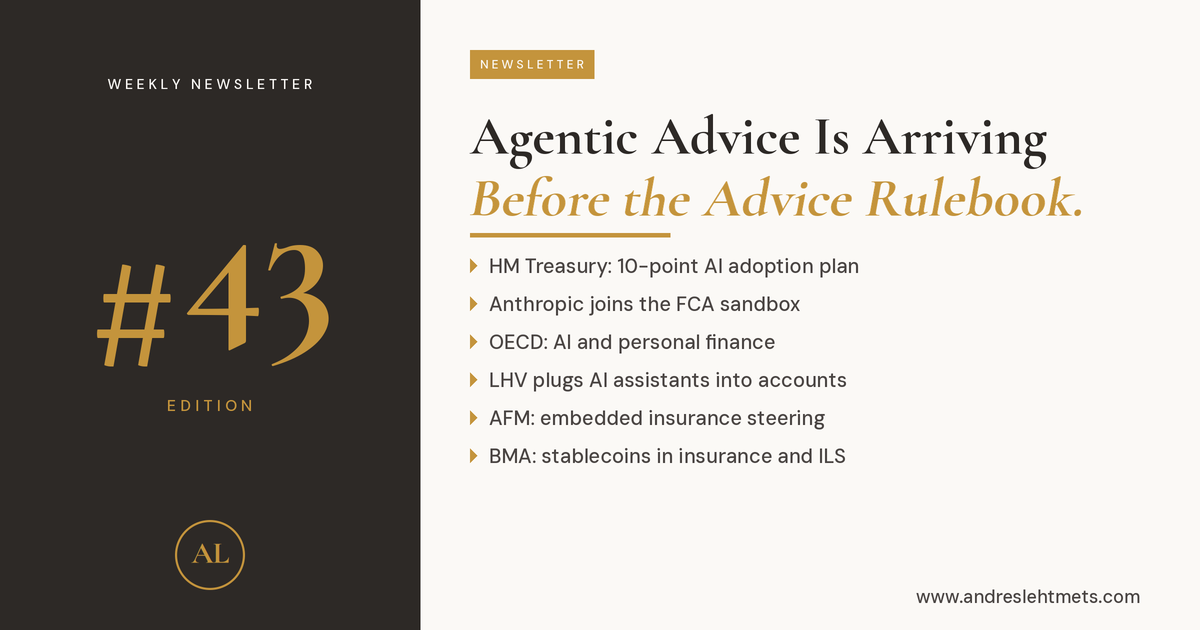
Agentic advice is arriving before the advice rulebook
The UK’s AI adoption plan · OECD on AI and personal finance · AFM on embedded insurance · Stablecoins in Bermuda · LHV AI
I was recently back at the IAIS FinTech Forum, the global supervisory community working on innovation in insurance, a group I was part of from its creation in my earlier supervisory life. It was a great pleasure to present the Cambridge Centre for Alternative Finance (CCAF) work on global AI adoption in financial services and what agentic AI could mean for supervision by 2030. My thanks to the whole team for having me back.
In other Cambridge news, the first cohort of our AI programme for public authorities has graduated. I developed the insurance part of the course and mentored capstone projects on agentic financial advice, and it was great fun to watch those projects come together. A new cohort starts in the autumn.
HM Treasury publishes a 10-point AI plan and the FCA puts frontier models in its sandbox
On 15 July HM Treasury published its Financial Services AI Adoption Plan, ten recommendations drawn up by the government’s AI Champions to scale AI across UK financial services. In condensed form:
- Regulators should coordinate so expectations of firms are clear and accessible.
- The FCA should comprehensively review the consumer, competition and wider impacts of advice-like outputs from general purpose large language models, then develop a policy and regulatory response with government.
- Adopt a consistent consumer disclosure for AI-driven services.
- Accelerate the Critical Third-Party regime, including assessment of key AI and cloud providers.
- Establish voluntary AI incident and near-miss sharing across the sector.
- Launch a voluntary, industry-led AI third-party assurance scheme.
- Encourage participation in the Financial Services Skills Compact.
- Explore a sector-wide financial services AI skills plan.
- Attract top global AI talent.
- Use the upcoming HM Treasury consultation to establish a trust framework for the agentic payments protocol.
Number 2 is the one I am watching most closely. Consumers did not wait for the advice rulebook to catch up with AI; they just started asking chatbots. A comprehensive supervisory review of what advice-like LLM outputs actually do to consumer outcomes is overdue, and the FCA is the first major regulator to be formally tasked with one.
A week later the plan got its practical illustration. On 22 July the FCA announced that Anthropic will support the second cohort of its Supercharged Sandbox, giving selected organisations access to Claude models on top of existing support from NayaOne and NVIDIA. Priority use cases range from agent-led payments and fraud detection to AI governance and widening access for underserved consumers.
This is what I call innovation facilitation 3.0. Version 1.0 was the regular sandbox: a safe space plus regulatory guidance. Version 2.0 was dedicated sandboxes built around concrete problems. Version 3.0 adds the actual technology, models, tools and compute, on top of the regulatory know-how.
Read the AI Adoption Plan · The FCA announcement.
OECD maps what AI is doing to personal finance, and who carries the risk
On 20 July the OECD published Artificial Intelligence and Personal Finance, a policy paper on how AI is changing where people go for financial information, learning and advice before making decisions about their money, their insurance cover and their pension.
The paper is balanced. On one side: advice becomes easier to reach, content adapts to the individual and decisions get more support. On the other: bias, invented answers, undisclosed commercial interest, open questions about the data and people left outside altogether. Whether any of it leaves households better off over a lifetime is, in the OECD’s own assessment, still unanswered.
The paper also sets out the specific capabilities people need in order to use these tools sensibly. That is where I would push back. Is it realistic to expect consumers to build those capabilities, or are we quietly moving the responsibility onto them? The history of financial education suggests a limit to what capability-building can carry. Read alongside the FCA’s new mandate to review advice-like LLM outputs in the article above, the supervisory community is starting to ask the same question from the other end: what the providers of these tools owe the people using them.
LHV opens customer bank accounts to AI assistants
On 15 July LHV, one of Estonia’s largest banks, launched LHV AI in beta: customers can now connect Claude, Cursor or any MCP-compatible AI assistant directly to their bank accounts through the open Model Context Protocol.
You authenticate exactly as you would in the internet bank: Smart-ID, Mobile-ID or biometrics. You choose what the assistant can see, account balances, transactions or both, and access is strictly read-only. Access tokens expire after one hour, connections must be renewed after 30 days, every request is logged and access can be revoked at any time. Then you simply ask your assistant what you spent on groceries last month or which subscriptions renewed this week, and it answers from your real data.
I spent years working on open insurance and open finance from the public policy and supervisory perspective, and this launch is interesting for three reasons.
- It answers a question I tried to shortcut myself a few months ago when I experimented with a “financial sherpa” setup over my own accounts. The demand is real, and now a regulated bank has built the front door.
- It raises a policy question: should PSD2-type access rights apply directly to consumers themselves, exactly as LHV has done voluntarily? And if I gave PSD2 access to consolidate my other bank accounts into LHV, would the assistant see those too? LHV does not offer that today, but the question will not stay hypothetical for long.
- Once your transaction history lands inside Claude or ChatGPT, it is no longer governed by banking regulation. It is governed by the AI provider’s own terms and privacy policy. Everyone opposing the EU’s Financial Data Access Regulation (FIDA) on the grounds that “Big Tech is coming to destroy our competitiveness” should sit with that for a moment. The data is already moving. The only question is whether it moves inside a European framework with access rules, security standards and redress, or outside one.
AFM: embedded insurance choice environments steer consumers towards overinsurance
In July the Netherlands Authority for the Financial Markets (AFM) published a review of 22 online choice environments selling embedded insurance: cover offered alongside flight and event tickets, package travel, electronics, phones and rental cars.
“Do embedded insurance. It’s easy money. You can charge more, commissions are higher, and customers don’t churn. They forget they even have it.” Not a literal quote, but that was the pitch I heard on stage at a fintech event a few years ago, with plenty of nodding in the room. The AFM has now documented exactly where that mindset leads.
The pattern across the 22 environments is consistent. Taking out the insurance is frictionless while declining it is tucked away. Benefits sit on the main page; limitations, cost and overlap with existing policies are buried in deeper layers. Layering itself is fine, but it needs to be designed well. Add security framing, “most popular choice” labels and countdown timers, and consumers are steered towards cover that may duplicate what they already hold.
The AFM is explicit that it did not assess legal compliance in this study. Reading it, though, it is often obvious that some of these designs ignore the basics. And the regulatory net is tightening: beyond insurance rules, the Consumer Rights Directive and the upcoming Digital Fairness Act target exactly the practices this report describes.
I remain a firm believer in embedded insurance. Cover offered at the moment you need it, when the product fits and delivers value for money, can reduce the protection gap. But that only works if the consumer comes first. Finance has a particular vulnerability here: one bad case erodes trust far beyond that one case. Easy money and forgotten policies is a strategy, just not one with a future.
Bermuda opens the first supervisory consultation on stablecoins in insurance and ILS
On 20 July the Bermuda Monetary Authority (BMA) published a consultation on the use of stablecoins by limited purpose insurers, insurance-linked securities (ILS) funds, investment funds and intermediaries. It is the first detailed supervisory consultation I have seen on stablecoins inside insurance and ILS structures.
The BMA is seeking feedback on eligibility criteria for recognised stablecoins, the scope of permitted use cases, exposure limits, ILS fund treatment, AML and sanctions controls, custody and safeguarding expectations, valuation and disclosure requirements, stress testing, concentration limits, cross-chain bridging restrictions and the supervisory notification process. The consultation runs until 30 September.
The bigger picture is that stablecoins are moving from niche instruments in digital asset markets into the operational fabric of institutional finance: payment, settlement, treasury management, collateral mobility and liquidity across insurance, reinsurance, investment funds and capital markets.
Insurance has real potential here, given how much money the industry moves globally. Premiums flow in one direction, claims in the other, often across borders and through multiple intermediaries, and every step adds time and cost.
Anthropic has appointed a Head of Business Risk & Insurance, recruited from Google after nearly eight years leading Alphabet’s actuarial function, with earlier actuarial roles at Berkshire Hathaway Specialty Insurance and WTW. The role covers building the company’s corporate insurance programme, and partnering with the insurance industry to co-create AI-centred coverage. The takeaway: frontier AI labs are becoming both vendors to insurers and insurance buyers, with exposures the market is still learning to price.
A companion of sorts to the personal finance paper above: AI and open data sharing are two of the most influential trends reshaping finance, yet their intersection remains understudied. This paper fills that gap, mapping mutually reinforcing benefits alongside added complexity, trade-offs and amplified risks, and closes with a forward-looking scenario of agentic AI operating in an environment of growing data sharing. Compulsory reading for anyone working on open finance, AI governance or FIDA. The LHV launch above suggests the forward-looking scenario is closer than the market assumes. Read the paper.
The July 2026 report covers the macrofinancial implications of AI (valuation concentration, hyperscaler debt financing, the interaction of AI investment with growth and sovereign debt) and frontier AI risks to financial stability (the pace of AI cyber capability and priorities for firms and authorities). It lines up closely with the ESRB warning and the ECB’s letter to bank CEOs covered in edition #42: the same direction of travel, now from a third institution. Read the report.
Applications to the second cohort of the FCA’s Supercharged Sandbox, up 51% from the first. When a regulator starts offering frontier models and compute alongside regulatory guidance, demand jumps by half. How long before firms start weighing jurisdictions by the quality of their sandboxes? FCA.
Weekly briefing on financial innovation and regulation. Join 5,000+ fintech, insurance and regulatory professionals.
SubscribeAdvisory for regulators, boards and fintech leaders navigating digital finance policy and regulation. See how I can help.
Selectively considering sponsorship for this newsletter. Reach 5,000+ decision-makers in financial innovation and regulation. Enquire.

Andres Lehtmets
Independent advisor on financial regulation and digital innovation. Former Senior InsurTech Expert at EIOPA. Research Analyst at Cambridge Centre for Alternative Finance. Writing weekly for 5,200+ professionals.