Weekly Edition
28 September 2026 · 9 min read
#47: The EU Digital Fairness Act is coming, and every financial services provider should follow it
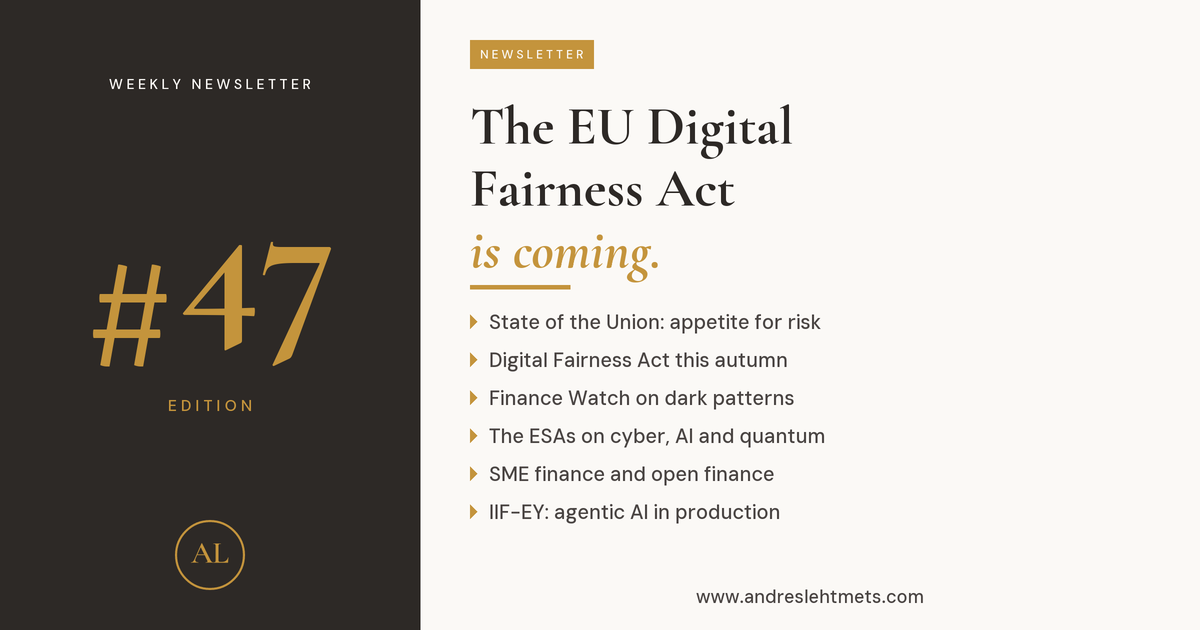
The EU Digital Fairness Act is coming, and every financial services provider should follow it
State of the Union: banking package, gold-plating, climate insurance and digital fairness · Finance Watch on dark patterns in retail investing · The ESAs on cyber, AI and quantum · SME finance and open finance
This edition is built around the State of the Union address of 16 September. For financial services it set the agenda for the year ahead: a new banking package, a push against gold-plating, a Climate Insurance Alliance and confirmation that the Digital Fairness Act will be proposed this autumn. The Digital Fairness Act gets a second article of its own, because a new Finance Watch study shows what it could mean in practice.
Some personal news. I am mentoring in the second season of the AI in Financial Services for Public Authorities online course run by the Cambridge Centre for Alternative Finance (CCAF) at Cambridge Judge Business School. Besides developing the insurance module, I will mentor capstone projects on agentic financial advice: practical work that participants take back to their own authority. The next cohort starts on 14 October.
In December I am speaking at the ERA Annual Conference on EU Financial Market Regulation and Supervision in Brussels (10 to 11 December), on agentic AI and its implications for financial advice. If you are in Brussels and would like to meet for a coffee, reply to this email.
Finally, Favikon has ranked me number 1 among insurance industry leaders in Estonia and number 9 among all LinkedIn creators in the country. I do not write for rankings. Financial innovation and regulation are complicated, a lot is moving at once and the connections matter. Thank you to everyone who reads, replies and disagrees with me.
State of the Union: Brussels starts speaking the language of business
On 16 September 2026 Commission President Ursula von der Leyen delivered her State of the Union address to the European Parliament. The speech signals which legislation, funding and priorities Brussels will take on in the coming year. This year the language was growth, speed and appetite for risk. Five points for financial services:
- A banking system built for growth. Von der Leyen called the work on the Savings and Investments Union (SIU) critical, but capital markets take time to develop and companies’ needs are urgent. Europe therefore needs a banking system geared to growth, not only to stability. The Commission will put forward a new Banking Package focused on simplification and tackling fragmentation. The line to remember: “We know the demand for capital is out there. But we need a greater capacity and appetite for risk.”
- A pact against gold-plating. The Commission’s omnibus proposals are reducing the administrative burden and the simplification work continues. This time the President also turned to the member states: “simplification cannot be a one-way street.” She proposed a pact under which member states commit not to add their own requirements when transposing EU law.
- Insurance, through the climate. After a summer of droughts, wildfires and heatwaves, von der Leyen noted that only around 25% of catastrophe losses in Europe are covered by private insurance, so national budgets far too often become the insurer of last resort. The Commission will set up a Climate Insurance Alliance, bringing insurers, investors, risk modelling specialists, public authorities and policyholders to one table to increase insurance uptake.
- The Digital Fairness Act. The speech confirmed the proposal will come this autumn. It is a horizontal act covering all sectors and the Commission’s main consumer protection initiative of this mandate. It targets four practices: manipulative interfaces (dark patterns), addictive design, influencer marketing and unfair personalisation, including pricing based on personal data. Banks, insurers, investment firms and fintechs should be ready to review product design and marketing, from the use of finfluencers to the gamification of investment apps and personalised pricing. More on this in Article 02.
- One Europe, One Market. The speech mentioned the political agreement on the One Europe, One Market Roadmap, which the Parliament, the Council and the Commission agreed in April and called completing the single market essential. Behind the short name sits a set of pending files that directly affect financial services, with the aim of agreeing them by the end of 2027: the supplementary pensions package (the review of the IORP II Directive and the PEPP Regulation), the market integration and supervision package, the digital euro and EU Inc, a pan-European corporate form meant to make it easier for companies, fintechs included, to start and scale across borders. The Financial Data Access Regulation (FiDA) is not on the list, as I wrote in edition #40. More on that in Article 04.
The message to financial services was clear. Brussels wants faster growth and less bureaucracy. The SIU is the longer project, and until it delivers, growth has to be financed by banks willing to lend more. Regulation can steer risk appetite only partly: the banking package and the gold-plating pact should give banks and investors more room, and the rest is up to market participants themselves.
Speed does not mean Europe is giving up its values. The Digital Fairness Act and the Climate Insurance Alliance show that while looking for growth, the EU also wants to protect consumers and society. Read the speech. · The One Europe, One Market Roadmap.
Finance Watch maps dark patterns in online retail investing ahead of the Digital Fairness Act
In September 2026 Finance Watch published a study on dark patterns, addictive design and misleading influencer marketing in Europe’s online retail investment market, based on market research carried out between April and June 2026. Some of the findings:
- Dark patterns. Giving more prominence to certain options when customers choose, hiding the full picture of costs and risks and using pre-selected or default options. Prominent “recommended” labels steer customers towards particular products, sometimes without any analysis of the customer behind them.
- Addictive design. Some providers send push notifications on price moves that cannot be switched off, nudging clients towards impulsive trades.
- Finfluencers. More than 54% of the finfluencer content examined was presented as education rather than advertising, although many finfluencers are paid by financial institutions. Of 59 pieces of content, only 17% communicated risk well and 58% did so poorly. Some content reaches, or even targets, minors.
The ESAs on cyber, AI and quantum: four points from the autumn risk update
On 23 September 2026 the European Supervisory Authorities (EBA, EIOPA and ESMA) published their Autumn 2026 update on risks and vulnerabilities in the EU financial system, this time as a slide deck. External dependencies, emerging technologies and private credit are the headline vulnerabilities. From the cyber and AI section:
- Dependence on ICT providers outside the EEA. Concentrated reliance on a small number of non-EEA providers makes cyber vulnerabilities worse. It also means depending on rules written somewhere else.
- AI makes attacks stronger and faster. Frontier AI models can find and exploit IT vulnerabilities at speed and scale. Attackers can find weak points faster than defenders can close them.
- Insurers are exposed twice. They use the technology themselves, and they insure everyone else who uses it. More frequent and severe AI-enabled attacks could raise claims and accumulation risk. In the longer term the ESAs expect repricing, stricter underwriting and more exclusions, which could reduce the cover available.
- Quantum. An advanced quantum computer could break some of the cryptography behind payments and databases, and data gathered today could be decrypted later (“harvest now, decrypt later”). The risk could arrive before anything useful is built with the technology. The ESAs point out that the Digital Operational Resilience Act (DORA) already requires state-of-the-art cryptography.
The ESAs’ announcement · the slide deck.
The FCA puts open finance to work for SME lending. The EU’s FiDA is standing still
On 17 September 2026 the FCA published a feedback statement (FS26/2) on supporting access to finance for small and medium-sized enterprises (SMEs). It found no evidence that FCA regulation is a major barrier. The problems lie mostly in information, capability and complex, duplicated application processes, and they hit microbusinesses hardest. Among the next steps, open finance stands out: SME lending is one of two priority use cases for the first UK open finance scheme.
SME lending is hard where limited financial information or thin credit histories make risk difficult to assess. More complete and timely data can reduce friction, support better lending decisions and help SMEs find more suitable products. The FCA maps the benefits across the lending journey:
- Pre-application. SMEs get a clearer and more complete picture of their own finances, helping them forecast cash flow and identify their needs and suitable products earlier.
- Application. Less cost, friction and duplication for both SMEs and lenders.
- Decision. Better information helps lenders make more informed decisions and allocate capital more efficiently.
The European angle. SME financing is an integral part of the SIU and of a more competitive Europe, and the EU’s Financial Data Access Regulation (FiDA) could tackle exactly this problem. It was proposed in June 2023, trilogues started in 2025 and agreement was expected by the end of that year. More than three years after the proposal, there is still no deal, and FiDA is not among the One Europe, One Market priorities. The UK is putting open finance to work for SMEs while the EU file stands still. The FCA announcement · FS26/2.
The eighth IIF-EY Global Annual Survey on AI Use in Financial Services, published on 17 September, covers 65 institutions in eight regions. The use of third-party models and infrastructure rose from 59% in 2023 to 88% in 2026, while 83% of firms cite restricted access to model architecture as a barrier to validation. Cost is a challenge for 50%, driven by tokenomics: the price per token falls, but advanced models use more tokens per task. All institutions with AI in production govern it through formal risk management, and 56% have built new governance frameworks for emerging use cases. The report.
Measuring financial health helps authorities see how financial services and policies affect people’s everyday lives, adding to the evidence they already use for policy and supervision. The new CGAP framework translates the G20 definition of financial well-being into six constructs and 17 indicators, combining administrative regulatory data with surveys. It sets out three uses: identifying vulnerable groups, assessing the effects of policies and spotting early signs of financial stress or consumer harm. Financial loss from fraud is one of the indicators, which makes it relevant in a digital finance context too. Authorities do not need all 17 indicators to start. The framework.
On 16 September Finland’s National Legal Services Authority, the Bank of Finland and the OECD published a proposed digital financial literacy strategy, supporting the national vision that Finns will have the world’s best financial literacy by 2030. Four objectives: strengthen adults’ digital financial literacy; reduce exposure to online scams and fraud; support long-term financial well-being through long-term investment and avoiding over-indebtedness; and strengthen stakeholder collaboration and impact assessment. I am glad insurance is reflected throughout the work. It seems obvious, but it is still too often forgotten. The announcement.
The share of financial institutions in the IIF-EY survey with agentic AI in production in 2026, up from 23% a year earlier.
Weekly briefing on financial innovation and regulation. Join 5,000+ fintech, insurance and regulatory professionals.
SubscribeAdvisory for regulators, boards and fintech leaders navigating digital finance policy and regulation. See how I can help.
Selectively considering sponsorship for this newsletter. Reach 5,000+ decision-makers in financial innovation and regulation. Enquire.

Andres Lehtmets
Independent advisor on financial regulation and digital innovation. Former Senior InsurTech Expert at EIOPA. Research Analyst at Cambridge Centre for Alternative Finance. Writing weekly for 4,700+ professionals.