2 April 2026 · 3 min read
EIOPA's Third IDD Report: What It Tells Us About Digital Distribution and AI
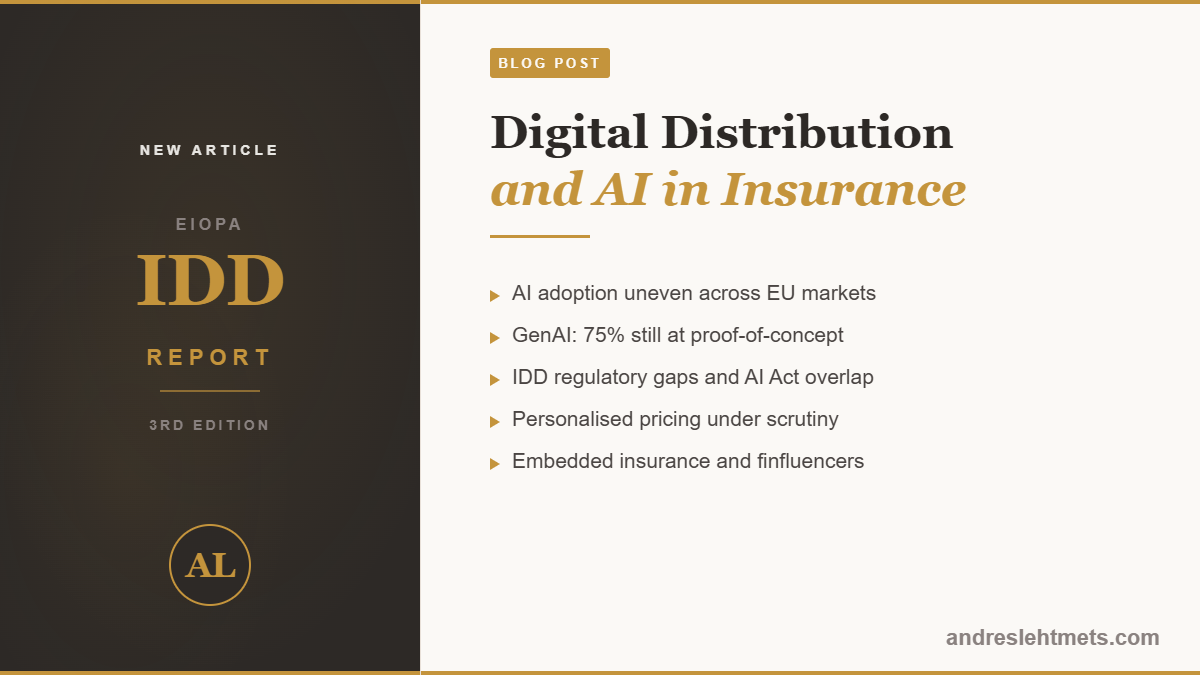
EIOPA just published its Third Report on the application of the Insurance Distribution Directive (IDD). It covers a lot of ground: market structure, cross-border activity, advice quality, sustainability disclosures and inducements. But the section on digitalisation and AI in insurance distribution is where things get most interesting.
The headline finding? Digital distribution in insurance is progressing slowly. Digital tools are mostly used for internal efficiency, not customer-facing distribution. Where digitalisation does reach the customer, it is concentrated on simple products like motor or travel insurance. Complex products, especially life insurance and IBIPs, still rely heavily on face-to-face advice.
This is consistent with EIOPA's earlier report on digitalisation of the European insurance sector, which found that digital-only distribution channels lag well behind physical or hybrid ones.
AI is growing, but unevenly
AI adoption in insurance distribution is expanding, but remains uneven across EU markets. Many insurers are still in exploratory or pilot phases. The most common applications include chatbots for customer service, sales support tools for cross-selling and upselling, targeted advertising and call centre sentiment analysis.
Generative AI is even earlier stage. According to EIOPA's recent GenAI survey, 65% of participating insurers reported using generative AI, but most use cases (64%) are back-office. For customer-facing applications, 75% are still at the proof-of-concept stage.
The regulatory gap is becoming harder to ignore
This is where it gets important. The IDD is technology-neutral, which was seen as a strength. But EIOPA now signals clearly that this neutrality creates gaps when it comes to AI-driven distribution.
Chatbots and automated advice tools can effectively replace human advisors in parts of the sales process. Yet Article 10 of the IDD requires distributors and their employees to possess adequate knowledge, skills and good repute. AI tools, as non-human entities, cannot fulfil this requirement. This raises unresolved questions around accountability and liability for AI-generated advice.
Add to that the cross-border dimension. AI tools operated by non-EU companies can provide advice to EU consumers without proper licensing. Supervisors find AI outputs difficult to investigate because responses vary across models and over time. Screenshots are sometimes the only available evidence.
AI Act meets IDD
The AI Act introduces a new regulatory layer that intersects with the IDD. The good news: many AI Act requirements around governance, human oversight and data quality can be met through adjustments within existing IDD and product oversight and governance (POG) frameworks, rather than through entirely new compliance structures. EIOPA's 2025 Opinion on AI governance and risk management already provides useful guidance here.
Other findings worth noting
Personalised pricing remains a supervisory concern. In the Netherlands, the AFM found that almost half of non-life insurers had higher profit margins on loyal customers than on newer ones. BaFin in Germany found similar patterns, with premium differentiation going beyond actuarial calculations.
Embedded insurance is growing, particularly through digital platforms, and raising questions about consistent IDD application across member states. The Dutch AFM recently published guidance covering licensing, product development standards and information obligations.
On the positive side, innovation facilitators are active. By 2023, the EU had 41 innovation hubs and 14 regulatory sandboxes across 12 countries, with over 6,000 firms approaching innovation hubs. Italy's IVASS has shut down more than 340 illegal insurance websites since November 2023 using a public whitelist of authorised intermediary domains.
My take
The IDD remains a solid framework. But the pace of AI adoption in distribution is outrunning the specificity of the rules. The combination of technology-neutral legislation with increasingly sophisticated AI tools creates a grey area that needs attention.
Furthermore, the upcoming Digital Fairness Act may address some of the topics flagged in this report, including finfluencers and personalised pricing. These are areas I will cover regularly in my newsletter.
This report, together with EIOPA's AI governance Opinion and the ongoing Retail Investment Strategy negotiations, signals that the regulatory treatment of AI in insurance distribution will be a key topic in the coming years.
Read the full EIOPA report here.

Andres Lehtmets
Independent advisor on financial regulation and digital innovation. Former Senior InsurTech Expert at EIOPA. Research Analyst at Cambridge Centre for Alternative Finance. Writing weekly for 5,200+ professionals.